IN-DEPTH
Carlos Figuero
Written by Íñigo de Barrón Arniches, a journalist who has worked for media outlets such as El País, where he was the Financial Correspondent between 2000 and 2022, Europa Press, and Expansión. He has also collaborated with various television and radio channels, including RTVE, La Sexta, Cuatro, COPE, Cadena SER, and Onda Madrid. Author of the book “El hundimiento de la banca” (The Collapse of Banking), among others, he has received several awards throughout his career, including the Schroders Award for Best Article of the Year and the ING Journalism Award.
“Luis Valls established honor loans; people gave their word that they would repay the money, and in almost every case, they did”
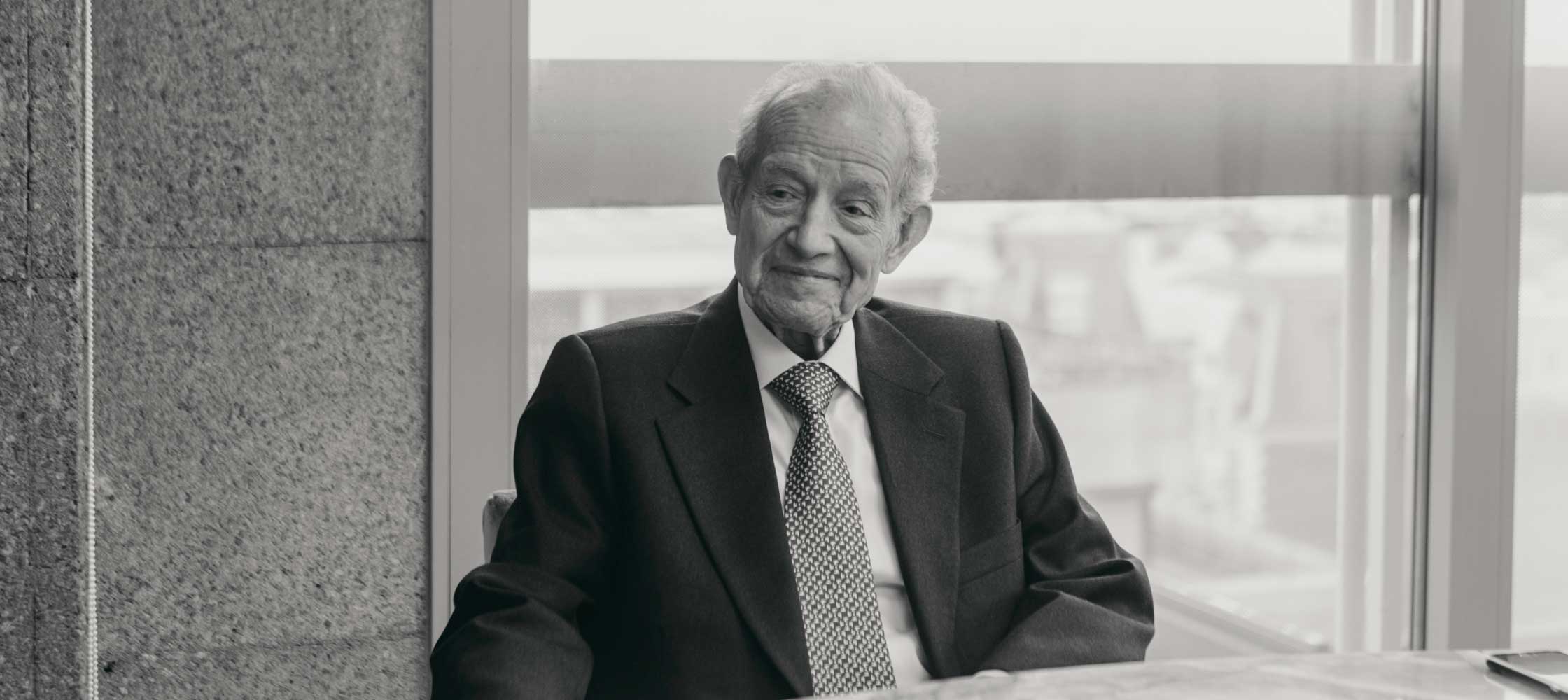
Carlos Figuero has worked practically his entire life at Banco Popular. Even though years pass through him, he still has a remarkable memory and recalls details from all those years when he was the CEO of social action organized by former Banco Popular president Luis Valls in 1965. After retirement, he continues this work as a volunteer, attending two afternoons a week on Tuesdays and Thursdays. He is a father of 7 and has 14 grandchildren, “Thanks to my wife’s sacrifice because I was at the bank all day,” he clarifies, to fairly distribute the credit. His great passion is the mountains he still visits, not for climbing any more, but for trekking. His work has been his vocation, and his eyes light up when discussing it. He describes Luis Valls as an “irreplaceable person for his exemplary nature”.
Question. How did you start at Banco Popular?
Answer. I began at Banco Mercantil e Industrial, which no longer exists. In 1961, I joined Banco Popular Español. Shortly afterwards, I was tasked with finding premises for a new financial entity, including the initial necessities such as an office in Madrid’s Barrio de Salamanca, secretaries, etc. Soon, the necessary professional team was formed and was directed by the Sole Administrator, José María de Arana Aizpúrua. Later, the new entity was absorbed by Banco Popular Industrial, located at Alcalá 40 in Madrid. The first president was Arana Aizpúrua. In 1965, the president of Banco Popular, Luis Valls, asked me to join the Presidency Office at Alcalá 26 in Madrid.
Q: Did the president separate social business from banking?
A: Yes, he said that in the mornings, he dealt with the bank, and in the afternoons, with the social world. And that’s how it was; we worked every afternoon until 8 or 9 PM because there was a lot to do, and Valls was meticulous about details.
Q: How many people were on the team?
A: There were about fifteen of us, including secretaries and those handling fiscal and legal matters. Some of these advisors worked voluntarily. The legal framework of the foundations and societies was complex and required permits. It took us time to create the entire structure. Funding came from directors’ allowances, which they waived at LV’s request, and from the rental income of the Beatriz building in Madrid, which the foundations owned.
Q: How long did you lead the social division?
A: About 40 years because LV didn’t want me to leave. When I turned 62, many colleagues retired, and I mentioned it to the president, but he suggested I continue. He was a man of few words, but his ideas were clear. When I turned 65 in 1999, the same thing happened. At 68, he tried to get me to continue, but I told him I was retiring, though I would keep working as a volunteer, unpaid. And that’s how I continue to this day.
Q: What happened with the bank’s resolution and Santander’s purchase?
A: After 2017, everything changed; Santander had its foundations, so there was no financial support. No money came from Popular’s board either, as that had all disappeared, leading to a merger of the foundations—there were nine, reduced to three—and the companies, of which there were about ten. From then on, the primary source of income was the rental of the Beatriz building in Madrid. This income drop forced a refocus of all the work due to the drop in capital.
Q: Rafael Termes, Popular’s CEO from 1966 to 1977 and president of the Spanish Banking Association (AEB), played an essential role in the foundations. How did this collaboration begin?
A: In 1987, Termes suggested to Valls that he increase international efforts and, with his own funds LV created Fomento de Fundaciones, Fundación Internacional, dedicated to social work. Today, it’s one of the foundations which continues our work.
Q: Was transparency in foundation accounts important to LV?
A: It was essential. He had a saying: “Everything we do should be publishable on the front page of El País,” meaning nothing hidden, nothing to be ashamed of.
Q: What was the legal control of the foundations like?
A: Foundation legislation has changed several times. I remember that, to adapt to one of the changes, the president asked me to meet the highest official responsible for foundations and invite him to the bank to see if we were doing anything wrong. He visited the bank and said our accounts and balances were perfect. LV wanted us to be exemplary in this regard.
Q: The foundations didn’t advertise their work. Why?
A: The president believed this work should be done for conviction rather than for rewards. He was also convinced that publicizing it would attract many people to seek help. With a few exceptions (for example, for convent repairs), money was never given outright but was lent in repayable aid. LV believed that gifted money isn’t appreciated and it was essential to retain resources to help more people, so it had to be repaid, though personal circumstances were always considered… the terms were very long.
Q: In this sense, it differed from other well-known foundations like Juan March, Rafael del Pino, Ramón Areces, etc…
A: Yes, we had conversations with some but found that our goals differed. We didn’t do any joint projects. Our vocation is social, not cultural, and through repayable aid, which complicates things more.
Q: How would you ask for interest from someone with few resources without financially strangling them? Wouldn’t that generate a default?
A: Undoubtedly. But knowing the person and the project, and with experience, you can give aid that can be repaid. Also, following up is essential as problems can arise along the way. In some cases, we also asked for guarantees to increase commitment. This was the case with student loans.
Q: In the religious field, what activities did you carry out during Luis Valls’ era?
A: In the past, in the 70s and 80s, there was significant work building churches in Madrid neighborhoods because there were churches in garages or similar places. I remember granting 500,000 pesetas over ten years for each church, interest-free. They repaid everything religiously, literally. We also helped religious individuals across Spain in convents and churches needing significant repairs. These were ageing buildings, and maintaining them wasn’t cheap. We supported about 31 convents, visiting most of them before giving the money. In these cases, annual assignments of 7,000 euros were fixed as grants. Now, there are only occasional aids.
Q: And with Opus Dei, was there a special relationship because the president was a numerary?
A: No special aid system existed because the applicant belonged to Opus Dei. The president disliked people flaunting their Opus Dei membership in request letters. Sometimes, he rejected them for this reason. He delegated this matter to me; he didn’t intervene. Luis Valls had an open mind, and Popular was among the first to support Santiago Carrillo’s Communist Party, Comisiones Obreras, etc., who, by the way, never left any loans unpaid.
Q: What other tasks did you undertake under Luis Valls’ presidency?
A: We mainly supported NGOs. Abroad, we assisted in Africa: Kenya, Ivory Coast, and South Africa partnering with others already working on projects with repayable aid. We preferred this system because the projects were more significant in amount and financially safer.
Q: And in Spain, what kind of aid did you provide?
A: It varied, from students to people asking for help buying a van to improve their business or buying furniture for a commercial space. They didn’t have a sufficient credit profile for Popular to grant them money, but if we saw them as trustworthy, we gave them an honor loan, meaning they promised to repay it. And they did in the vast majority of cases.
Q: How was your final interaction with Luis Valls?
A: Our last meeting was on October 11, 2005. Although we had more meetings at home, he never returned to the bank. Francisco Aparicio took over. The former president died on February 25, 2006.